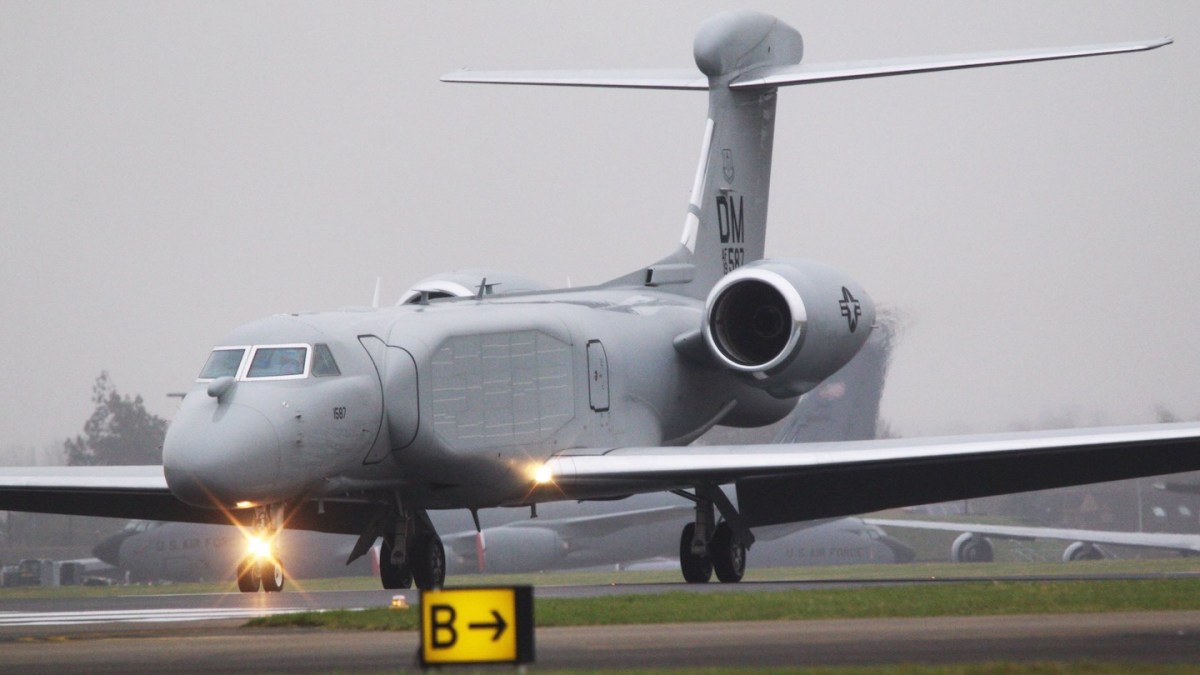
As the United States intensifies its electronic warfare capabilities, the deployment of the EA-37B 'Compass Call' electronic attack jets has emerged as a pivotal move in the evolving landscape of modern conflict. These aircraft, designed to disrupt enemy communications and radar systems, represent a significant leap in the U.S. military's ability to project dominance in contested environments.
Is the U.S. Using Electronic Warfare to Undermine Iran's Strategic Capabilities?
The recent deployment of the EA-37B 'Compass Call' to the Middle East is not a one-time tactical adjustment but a calculated shift in how the U.S. approaches asymmetric warfare. Unlike traditional kinetic strikes, electronic attacks target the infrastructure that underpins an adversary's operational effectiveness—communications, surveillance, and command-and-control networks. This approach allows the U.S. to neutralize threats without direct physical confrontation, a critical advantage in regions where conventional military engagement could escalate tensions.
Historically, electronic warfare has been a tool for intelligence gathering and battlefield deception, but today, it has evolved into a core component of integrated air and space operations. The EA-37B 'Compass Call' exemplifies this transformation by incorporating advanced signal-jamming technology capable of disrupting multiple frequencies simultaneously. Its deployment to the Middle East, particularly in proximity to Iran, signals a strategic pivot toward preemptive disruption of Iranian missile and drone operations, which have increasingly relied on sophisticated communication systems.
- Real-time disruption of radar and satellite communications to prevent enemy targeting
- Enhanced jamming capabilities targeting both military and civilian infrastructure
- Adaptive frequency targeting to counter evolving Iranian electronic defense systems
What makes the EA-37B 'Compass Call' particularly effective is its ability to operate in contested airspace while maintaining stealth and low observability. This capability is essential in regions where Iran has developed countermeasures, such as the use of cyber-physical systems to mitigate electronic attacks. The U.S. military’s focus on this type of asymmetric warfare reflects a broader shift toward non-kinetic operations, which have become increasingly vital as adversaries develop more sophisticated electronic countermeasures.
The implications of this deployment extend beyond immediate tactical advantages. By integrating electronic warfare into its overall strategy, the U.S. is redefining how it engages in regional conflicts. The EA-37B 'Compass Call' is not just a tool for immediate tactical gain but a strategic enabler for long-term operational resilience, ensuring that U.S. forces can operate effectively even in environments with dense electronic interference.