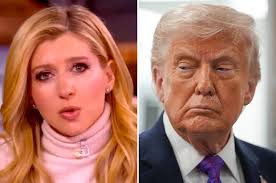
The View guest co-host Sara Eisen recently ignited a heated discussion during her segment on the popular daytime talk show, sparking immediate audience reactions and panel disagreements after she defended Donald Trump’s decision to escalate U.S. military involvement with Iran. The segment, which aired on Wednesday, highlighted tensions around national security, foreign policy, and the evolving geopolitical landscape. Eisen, a 41-year-old CNN News anchor who stepped in for regular co-host Alyssa Farah Griffin during maternity leave, addressed the recent resignation of the National Counterterrorism Center’s director, Joe Kent, who cited his inability to 'in good conscience support the ongoing war in Iran' due to perceived lack of imminent threats.
Eisen’s defense of Trump’s stance on Iran—described by some as 'unsubstantiated' by critics—prompted the audience to burst into laughter, with many viewers expressing skepticism about the U.S. military’s role in the region. The panelists, including hosts such as Rachel Ray and co-hosts like Lisa Lue, quickly shifted the conversation to economic implications, with Eisen arguing that the U.S. economy remains 'in pretty good shape' despite rising inflation and energy costs. This comment, highlighted by Fox News as a 'feud starter,' led to immediate backlash from the audience and confusion over policy priorities.
During the segment, Eisen’s remarks about the U.S. war on Iran being 'driven by pressure from Israel and its powerful America' were met with sharp criticism from the panel. One panelist noted that the statement seemed to conflate international alliances with national interests, while another questioned the accuracy of the claim that Iran posed 'no imminent threat' to the U.S. The discussion revealed deep divisions among experts on the implications of U.S. foreign policy, particularly regarding the role of diplomacy versus military action.
Eisen’s role as a guest host on a platform like The View has raised questions about the influence of media on public perception of foreign policy. Her comments, while framed as policy analysis, reflect broader debates about the U.S. government’s approach to international relations and the challenges of balancing national security with global cooperation. The segment underscores the role of media platforms in shaping public understanding of complex geopolitical issues, especially when they feature prominent figures like Eisen, who has a background in news and policy analysis.
As the debate continues, the incident highlights the need for careful communication about military interventions and the risks of oversimplifying foreign policy debates. The audience’s laughter suggests a disconnect between the guest host’s framing and the broader context of U.S. military operations in the Middle East, where the threat of Iranian actions remains a critical concern for many policymakers.