Global Stress and Anxiety Trends Across Nations: A Comparative Analysis of National Well-Being

Editor 09 Feb, 2026 ... min lectura

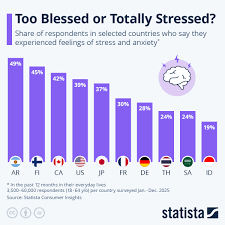
The latest findings from Statista Consumer Insights reveal a striking global disparity in stress and anxiety levels among populations. This comprehensive survey, which surveyed over 500,000 individuals across 150 countries, identifies nations with particularly high rates of stress and anxiety, as well as those that report significantly lower levels of these emotional challenges. The data shows that certain regions consistently demonstrate higher levels of psychological distress, while others maintain remarkably calm and resilient populations.

Argentina, Canada, Finland, Australia, Mexico, Sweden, South Africa, and the Philippines emerged as the most affected nations, with more than 40 percent of respondents reporting habitual stress and anxiety. These countries share a common thread: their populations experience significant daily challenges that manifest as chronic emotional distress. The high rates in these nations suggest complex social, economic, and cultural factors influencing mental health outcomes. For instance, South Africa's high rate may be linked to economic inequality and political instability, while the Philippines' elevated numbers could reflect the strain of rapid urbanization and economic pressures.

On the other end of the spectrum, Indonesia and Thailand report the lowest rates of habitual stress and anxiety, with only 19 percent of respondents experiencing these conditions regularly. These countries demonstrate notable resilience despite their diverse landscapes and complex social dynamics. Thailand's relatively low stress levels might be attributed to strong community bonds and cultural practices that promote mental well-being, while Indonesia's calm demeanor could stem from its rich cultural traditions and community support systems.

The data also highlights interesting patterns in European and Middle Eastern nations. German-speaking countries, including Germany, Switzerland, and the United Arab Emirates, consistently report stress and anxiety levels below 30 percent. This contrast with countries like Sweden, which has one of the highest rates globally at 43 percent, underscores the nuanced relationship between cultural values, economic policies, and mental health outcomes. The absence of significant stress in German-speaking nations may reflect their strong social safety nets and high levels of work-life balance.

Notably, the survey reveals that while some Asian countries like South Korea (40 percent) and Japan (37 percent) also show high stress levels, this isn't universal across the region. This variation within Asia highlights the need for tailored approaches to mental health interventions. Countries like Singapore and Malaysia, which are also in the high-stress category, have unique challenges related to rapid development and urbanization that differ from their neighbors.

These findings provide valuable insights for policymakers, health organizations, and international development agencies. By understanding these patterns, governments can better target interventions and develop culturally appropriate mental health strategies. The data suggests that certain cultural practices, socioeconomic conditions, and policy frameworks significantly influence mental health outcomes globally.