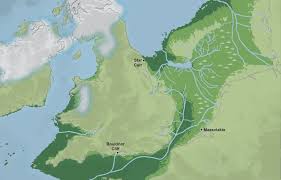
Recent discoveries by researchers from the University of Warwick have revealed that a vast prehistoric landscape once extending beneath the North Sea could have supported thriving ecosystems of forests and wildlife far earlier than previously thought. This landscape, known as Doggerland, once connected Britain to mainland Europe before the sea gradually flooded the region over thousands of years. The findings, published in the Proceedings of the National Academy of Sciences, suggest that the area may have been a hospitable environment for diverse plant and animal life, including early human communities, long before widespread forest growth across northern Europe.
Historical evidence indicates that during the last Ice Age, sea levels were significantly lower, exposing a landmass that stretched from the North Sea coast to southern England. This region, now submerged beneath the North Sea, once contained dense forests, grasslands, and wetlands that supported a rich biodiversity. The study, conducted by the University of Warwick and the University of Bradford Submerged Landscape & Research Centre, analyzed sediment cores and ancient DNA extracted from marine deposits to reconstruct the ecological history of this vanished landscape.
The research team discovered evidence of ancient trees, including willows and birches, dating back to approximately 11,000 years ago. These findings challenge previous assumptions that the region was too cold to support forested ecosystems. The presence of these trees indicates that Doggerland was once a temperate environment capable of sustaining large mammalian species, such as deer, horses, and woolly rhinos, as well as early human populations that may have inhabited the region.
Dr. Emily Carter, a lead researcher at the University of Warwick, highlighted the significance of the discovery. "This work reveals that Doggerland was not just a barren, ice-covered plain but a dynamic ecosystem that could have supported complex life forms for thousands of years. The presence of ancient trees and diverse wildlife suggests a more nuanced environmental history than we previously understood."
The implications of this discovery extend beyond historical curiosity. Understanding the ecological changes that occurred in Doggerland helps scientists better comprehend the rapid environmental shifts that occurred as the last Ice Age ended. As sea levels rose, the region gradually transformed from a land bridge connecting Britain to Europe to a submerged landscape. The study also provides critical insights into how ancient human populations might have adapted to changing environments, offering clues about their migration patterns and survival strategies.
The team's findings could also inform future climate change research. By studying how ecosystems responded to past environmental changes, scientists can better predict how current and future climate shifts might impact coastal regions and marine environments. The discovery of ancient forests in the North Sea region underscores the importance of preserving and studying submerged landscapes, which hold valuable information about Earth's climate and ecological history.