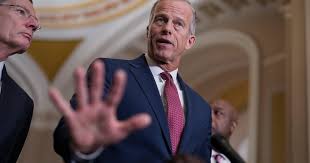
Senate Majority Leader John Thune has signaled that the SAVE America Act, a proposed federal elections bill, faces significant hurdles in becoming law despite President Trump's threats of a legislative blockade. The legislation, which the House recently approved, mandates citizenship verification for voter registration and photo identification for ballot casting. Thune's skepticism about the bill's chances of passage highlights growing tensions within the Republican Party over the bill's scope and implementation.
The SAVE America Act, formally known as the Secure and Verify American Elections Act, aims to enhance voter authentication while addressing concerns about election integrity. However, President Trump has demanded additional provisions, including a ban on mail-in ballots and restrictions on transgender athletes in women's sports, as well as gender-affirming healthcare for minors. These demands have created a complex interplay between the administration's agenda and congressional opposition.
Thune's statement that 'there are no easy ways to do this' underscores the challenges of reconciling the bill's requirements with the broader political landscape. The legislation's push for stricter voter identification has drawn support from some conservative factions but faces resistance from progressive Democrats and other Republicans who view it as overly restrictive. This divide has intensified as the bill moves through the Senate, where compromise remains difficult.
Analysts suggest that the inclusion of contentious elements, such as restrictions on transgender athletes and gender-affirming care, has complicated the bill's path to approval. While the bill's focus on voter ID has been praised by some as a necessary step to prevent fraud, the added provisions have sparked debates over civil liberties and fairness. Thune's stance reflects a broader strategy by Republicans to balance electoral security with legislative pragmatism.
Political experts note that the administration's demand for the bill to include additional restrictions has created a 'perfect storm' of opposition. The bill's original purpose, to combat voter fraud, now appears to be overshadowed by these added demands. This situation highlights the challenges of legislative coordination between the executive and legislative branches, especially when the president's agenda conflicts with congressional priorities.
The controversy also raises questions about the future of federal voting reforms. With the House already having passed the bill, the Senate's ability to finalize it without significant revisions is uncertain. Thune's comment that the bill 'faces an unlikely path to passage' suggests that without major adjustments, it may not secure the necessary support to become law.
As the debate continues, the SAVE America Act has become a focal point for discussions on voter authentication, civil rights, and the balance between security and individual freedoms. The outcome of this legislation could set a precedent for future electoral reforms, with implications extending beyond the current political climate.