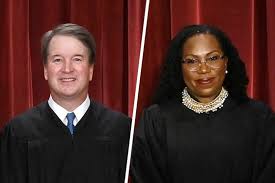
On March 9, 2026, a significant moment in the Supreme Court's internal dynamics unfolded as Justices Ketanji Brown Jackson and Brett Kavanaugh engaged in a rare public discussion regarding the court's approach to emergency cases involving former President Donald Trump. The exchange, captured by NBC News, highlighted deepening ideological rifts within the nation's highest court over how judicial decisions impact presidential executive actions.
The confrontation centered on the Supreme Court's role in reviewing and potentially overturning lower court rulings that have previously obstructed President Trump's policy initiatives. Jackson, a prominent advocate for judicial restraint and procedural fairness, argued that the court's emergency handling mechanisms have created a 'warped' process that disproportionately affects politically sensitive cases. She emphasized that the current system risks undermining the judiciary's independence and eroding public trust in the courts' impartiality.
Kavanaugh, representing the conservative majority, defended the court's emergency procedures as necessary safeguards against potential executive overreach. He asserted that these measures are critical for maintaining judicial integrity and preventing courts from becoming mere political tools. His stance reflects the broader conservative strategy of ensuring that the Supreme Court remains a check on the executive branch, even when faced with contentious political appointments.
The disagreement has raised questions about the future of judicial review and the balance between judicial independence and political accountability. Jackson's critique of the court's emergency docket, particularly its application to cases involving Trump, underscores the challenges of navigating high-stakes litigation in an increasingly polarized political landscape. This conflict also highlights the complexities of the Supreme Court's evolving role in addressing the executive branch's actions and its capacity to act as an independent arbiter of constitutional interpretation.
Legal experts suggest that the clash between Jackson and Kavanaugh reflects a larger tension within the Supreme Court regarding the interpretation of judicial review and the application of emergency procedures. The outcome of this debate could influence how future cases involving presidential actions are handled, particularly in the context of ongoing political and legal challenges.