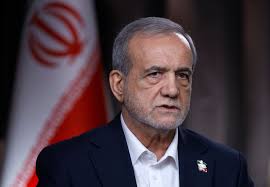
Iranian President Masoud Pezeshkian has delivered a notable message of de-escalation in regional conflicts, signaling a potential shift in Iran's foreign policy stance. His recent address highlighted a complex interplay between diplomatic outreach and domestic political pressures. The move comes amid heightened tensions in the Middle East, where Iran has been a key player in regional security dynamics. Pezeshkian's statement, though framed as a step toward reducing hostilities, carries significant implications for Iran's relationship with neighboring countries, particularly Gulf states and other regional actors.
The CNN analysis emphasizes that Pezeshkian's message of de-escalation is not a complete reversal of Iran's aggressive posture but rather a strategic response to immediate regional pressures. His address included an apology to countries in the region that had been attacked, which has drawn mixed reactions. While some view this as a proactive step toward peace, others see it as a calculated move to gain domestic support amid internal divisions.
Key to understanding this shift is the context of recent military and economic confrontations between Iran and its neighbors. Pezeshkian's apology to neighboring countries, as reported by The Guardian, has sparked internal backlash from hardliners within the Iranian government. This internal tension reflects a broader ideological divide between reformist and conservative factions in Iran's political landscape. The apology, while intended to foster goodwill, has been met with skepticism by hardline elements who perceive it as a concession to external pressures.
The New York Times' analysis further underscores the delicate balance Pezeshkian faces. His apology to Gulf states, which have historically been at odds with Iran, is seen as a critical moment in Iran's evolving foreign policy. The move highlights the challenges of maintaining regional stability while navigating internal political dynamics. Pezeshkian's message of de-escalation is not a unilateral gesture but a response to complex geopolitical realities, including the ongoing conflict in Gaza and broader Middle Eastern tensions.
The implications of this message extend beyond immediate diplomatic relations. By acknowledging past attacks on neighboring countries, Pezeshkian is attempting to build a foundation for future cooperation. However, this gesture has also intensified the internal debate within Iran's government. Hardliners argue that such gestures could be perceived as weakness, while reformists see it as a necessary step toward regional reconciliation. This divide has created a political vacuum that could influence future policy decisions.
The timing of this message is particularly significant given the current state of Iran's economy and international sanctions. Pezeshkian's focus on de-escalation could be interpreted as an attempt to mitigate economic pressures by reducing military spending and fostering economic partnerships. However, this approach has not been universally welcomed, as some analysts argue that it could undermine Iran's strategic positioning in the region.
International observers are watching closely as Pezeshkian's message unfolds. The response from Gulf states and other regional actors will be crucial in determining whether this de-escalation effort leads to tangible progress or further instability. The success of this initiative depends on the ability of Iran to balance its domestic political needs with its regional security interests.