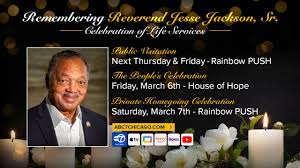
Rev. Jesse Jackson, the iconic civil rights leader whose work reshaped American history, passed away at 84 on Tuesday, March 3, 2026, after a battle with a rare neurodegenerative disease. His family and the Rainbow PUSH Coalition have announced expanded memorial services across Chicago, South Carolina, and Washington, D.C., reflecting the global impact of his lifelong advocacy for racial justice and social equity. The services, now spanning three states, underscore Jackson's enduring influence on civil rights movements and his ability to connect with diverse communities worldwide.
The announcement marks a significant shift in honoring Jackson's legacy, moving beyond traditional funeral rites to create a multi-state memorial that acknowledges his extraordinary contributions to the civil rights movement. With services now held in Chicago, South Carolina, and Washington, D.C., the event aims to unite supporters from across the country and internationally. Jackson's wife, Jacqueline, who has been his partner for over six decades, is central to this effort, highlighting the personal and political dimensions of his life's work.
Jackson's death has sparked widespread reflection on his role in pivotal civil rights milestones, including the 1960s civil rights movement, the introduction of the Equal Protection Clause, and his leadership in the fight against systemic racism. His advocacy for marginalized communities and his role in shaping modern social justice movements continue to resonate globally, influencing activists and policymakers alike. The expanded services reflect the breadth of his impact, from grassroots organizing to high-level national policy discussions.
The Rainbow PUSH Coalition, founded by Jackson in 1985, has been instrumental in advancing civil rights through education, community empowerment, and political engagement. The coalition's decision to host services in multiple states demonstrates Jackson's deep roots in the communities he served, from urban centers like Chicago to rural areas in South Carolina. This expansion also highlights the decentralized nature of his influence, which extended far beyond the national stage to local initiatives across the country.
Notably, the services include prominent figures such as former President Barack Obama, former President George W. Bush, and former President Bill Clinton, who have expressed their admiration for Jackson's work. Their participation underscores the cross-generational and bipartisan nature of his influence on American politics and social movements. The inclusion of these leaders in the memorial services highlights the enduring relevance of Jackson's message on racial equality and social justice.
Jackson's legacy is further cemented by his role in shaping modern civil rights discourse, including his advocacy for the Equal Protection Clause, his work with the Black Panther Party, and his efforts to address economic disparities in marginalized communities. His death has prompted a renewed focus on the importance of preserving civil rights history and continuing the fight for systemic change.
The expanded services also reflect the evolving nature of memorialization in the digital age, where virtual and physical spaces are increasingly integrated to honor historical figures. While traditional funerals have long been a means to pay tribute, Jackson's approach emphasizes community-centered, inclusive events that bring together diverse voices and perspectives.
As the memorial services unfold across multiple states, the world will have the opportunity to reflect on Jackson's profound impact on civil rights history, his innovative approaches to social justice, and the ongoing challenges of achieving true equality in American society. His death serves as a reminder of the need for continued action in the pursuit of a more just and equitable future.