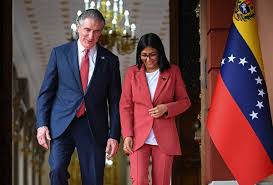
The United States and Venezuela have reached a historic agreement to restore full diplomatic relations following months of strained ties. This move, spearheaded by U.S. Interior Secretary Doug Burgum’s recent visit to Caracas, marks a pivotal shift in the bilateral relationship, with significant implications for both nations’ economic and energy landscapes. The decision reflects a broader strategic recalibration as Washington seeks to diversify its engagement with Venezuela beyond its once-dominant oil sector.
Under the new framework, U.S. officials emphasized the potential for expanded access to Venezuela’s vast mineral resources, including gold, copper, and rare earth elements. Burgum’s visit underscored a clear pivot from the previous focus on oil, with Washington identifying mining as a critical avenue for economic stability and resource security. This initiative aims to address longstanding challenges in the U.S. supply chain, particularly the growing demand for critical minerals essential for renewable energy technologies and advanced manufacturing.
The announcement has been met with cautious optimism by analysts, who highlight the strategic importance of Venezuela’s rich deposits of lithium and other minerals. However, challenges remain, including the complex political dynamics within Venezuela’s current government, the need for robust regulatory frameworks, and the risk of geopolitical tensions resurfacing. The U.S. government has positioned this as a constructive step toward long-term economic cooperation, though implementation will depend on mutual trust and transparency.
The restoration of diplomatic relations also signals a potential easing of sanctions that have previously hindered trade and investment in the region. By prioritizing mining access, the U.S. hopes to unlock new opportunities for collaboration in a rapidly evolving global market. Yet, the success of this initiative will hinge on overcoming historical mistrust and ensuring that the new partnership aligns with the needs of both nations’ citizens.
Experts caution that while the initial steps are promising, the full realization of this agreement will require sustained effort and a phased approach. The U.S. must balance its immediate economic interests with the broader goal of fostering sustainable development in Venezuela, which has been grappling with economic instability and infrastructure challenges for years. This shift represents a critical juncture in the evolving relationship between the two countries, with potential ripple effects across Latin America and beyond.