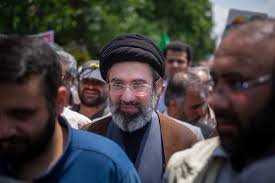
Iran's leadership transition following the death of Ayatollah Ali Khamenei, the country's supreme leader, has intensified global concerns over the country's political future. The selection of Mojtaba Khamenei, the son of the late leader, as a leading contender for succession has sparked widespread analysis of Iran's internal dynamics and international implications. With the Assembly of Experts still deliberating, analysts suggest the process could take months, creating a period of uncertainty for regional stability.
According to Israeli Defense Minister Israel Katz, the upcoming successor is described as 'an unequivocal target for elimination.' This stark assessment reflects the high stakes involved in Iran's leadership vacuum. The current political environment, marked by ongoing conflicts with the United States and Western powers, has intensified fears that the new leader's appointment could significantly alter Iran's foreign policy trajectory, particularly in light of recent military engagements and economic pressures.
The potential succession of Mojtaba Khamenei, a young and relatively untested figure in Iranian politics, raises questions about the continuity of the Khamenei family's influence within the Islamic Republic. As a direct heir to a regime that has previously maintained strong ties with regional allies, Mojtaba's rise could signal a shift toward more aggressive or pragmatic strategies, depending on his alignment with traditional conservative factions and emerging reformist elements within the Iranian establishment.
Iran's formal process for selecting a new supreme leader is governed by the Assembly of Experts, a body composed of religious and political figures who have been criticized for their lack of transparency and delayed decision-making. The delay in announcing the successor has led to speculation that the process may be deliberately extended to allow for more thorough vetting, particularly given the geopolitical tensions involving Iran and its neighbors, including Israel and Saudi Arabia.
Analysts have highlighted the strategic implications of this transition. If Mojtaba Khamenei is confirmed as the next supreme leader, he would inherit a complex legacy of international isolation, economic sanctions, and regional conflicts. His ability to navigate these challenges will be critical to Iran's future, especially in managing relations with key stakeholders like the United States, China, and the Gulf states.
The international community remains cautiously optimistic that the transition process will be conducted peacefully, but the absence of concrete information about the new leader's background and policies has raised concerns about potential instability. The United States and its allies continue to monitor the situation closely, with some warning that a prolonged period of uncertainty could exacerbate existing tensions and lead to further escalation in the Middle East.