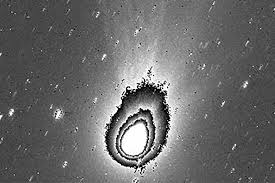
European Space Agency's Jupiter Icy Moons Explorer (Juice) has captured unprecedented images of interstellar comet 3I/ATLAS, marking a significant milestone in space exploration. The spacecraft, en route to Jupiter, obtained these images while the comet was near the Sun, revealing a dynamic environment of dust and gas emissions.
The newly released images show a prominent bright halo of gas surrounding the comet's head, known as the coma. Scientists also observed a long tail extending from the comet, alongside intricate structures including rays, jets, and filaments. These features provide crucial insights into the composition and behavior of interstellar comets, which are believed to carry primitive organic molecules essential for life's origins.
3I/ATLAS, designated as an interstellar object, is traveling through our solar system at an average speed of 26 kilometers per second. Its discovery has been pivotal for understanding the distribution and characteristics of interstellar material. The data collected by Juice will help scientists analyze how such objects interact with the solar wind and planetary environments.
The images were processed using advanced techniques by teams at the International Gemini Observatory and the National Optical Astronomy Observatory. These images, captured through the Juice mission's science camera, reveal the comet's complex structure, including the coma and tail structures that indicate active outgassing from the nucleus.
Researchers have identified potential organic molecules in the comet's tail, which could be precursors to life. This discovery aligns with ongoing efforts by the Search for Extraterrestrial Intelligence (SETI) initiative to find evidence of life beyond Earth.
The Juice mission, launched in 2023, aims to study Jupiter's icy moons, particularly Ganymede, Europa, and Callisto. This new data from 3I/ATLAS provides a unique opportunity to study interactions between interstellar comets and the solar system.
Scientists continue to analyze these images to understand the role of interstellar comets in the formation of planetary systems. The data collected will contribute to models of stellar evolution and the propagation of organic materials throughout the galaxy.
Future observations of 3I/ATLAS could help clarify its origin, whether it originated from the Oort cloud or another stellar system. This discovery is part of a broader effort to understand the interstellar medium and its influence on our solar system.