New Insights on Interstellar Comet 3I/ATLAS: Close-up Images from Jupiter's Orbiter

Editor 05 Mar, 2026 ... min lectura

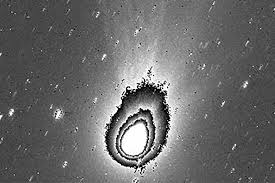
The European Space Agency's Jupiter Icy Moons Explorer (JUICE) mission has captured groundbreaking images of interstellar comet 3I/ATLAS, marking the first time an interstellar object has been observed in such detail from deep space. These images, taken by the spacecraft as it travels toward Jupiter, reveal a complex structure including a prominent gas halo known as the coma, elongated dust tails, and dynamic jets of material ejected by the comet. The observations provide unprecedented insights into how interstellar comets interact with stellar environments.

Scientists from the European Space Agency and international teams have analyzed these images, which were captured when the comet was in close proximity to the Sun. The images show a bright, luminous coma surrounding the comet's nucleus, with fine filaments and high-speed jets streaming outward. This phenomenon is critical for understanding the composition and behavior of interstellar comets, which are believed to carry information about the early solar system and potential prebiotic chemistry.

The discovery of these detailed features offers a unique opportunity to study the physical processes at work in interstellar environments. Unlike comets within our solar system, interstellar comets like 3I/ATLAS are not influenced by planetary gravity, allowing scientists to observe their natural evolution without gravitational perturbations. This data is invaluable for models of star formation and the distribution of organic molecules throughout the galaxy.

The images also highlight the capabilities of the JUICE mission, which is designed to explore Jupiter's icy moons while studying the dynamics of comets and other celestial bodies. By capturing these images from a distance of over 500 million kilometers, the mission has demonstrated its ability to gather high-resolution data on objects far beyond the inner solar system.

Researchers emphasize that the observations of 3I/ATLAS provide a rare window into the composition of interstellar material. The data collected could help scientists better understand the origins of organic molecules, which are essential for life as we know it. The presence of complex organic molecules in the coma of 3I/ATLAS suggests potential pathways for prebiotic chemistry, a field of study that has long been associated with the search for life in the universe.

As the JUICE spacecraft continues its journey toward Jupiter, future observations of 3I/ATLAS will likely reveal more intricate structures, including the interaction between the comet's material and the solar wind. This ongoing study is part of a broader effort to map the distribution of interstellar objects and their role in the chemical evolution of the galaxy.