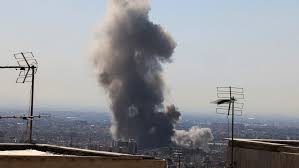
Israel and the United States have intensified military operations against Iranian targets in the Middle East following the death of Iran's Supreme Leader Ayatollah Ali Khamenei, marking a significant escalation in regional tensions. This coordinated offensive, which includes strikes in both Iran and Lebanon, has drawn sharp responses from Tehran and raised concerns about the broader implications for regional stability and U.S. foreign policy.
Iran's Secretary of the Supreme National Security Council, Ali Larijani, has publicly accused the U.S. of shifting its foreign policy rhetoric from 'America First' to 'Israel First,' claiming that Tehran will not negotiate with Washington. Larijani stated that President Donald Trump's actions have created 'delusional fantasies' that risk further regional chaos, particularly as U.S. and Israeli forces conduct joint strikes against Iranian assets. This rhetoric highlights the deepening rift between Tehran and Washington, with Iran framing the attacks as a direct response to perceived U.S. support for Israeli military actions.
The conflict has intensified amid conflicting claims about responsibility for recent attacks. Hezbollah has claimed responsibility for projectiles fired at Israeli positions, while Israel has accused Iranian proxies of orchestrating retaliatory strikes. These incidents reflect the complex web of alliances and adversities that define the Middle Eastern geopolitical landscape, where every action by one nation can trigger cascading consequences across multiple fronts.
Analysts suggest that the U.S. and Israel's decision to target Iranian infrastructure and military assets stems from a combination of strategic imperatives and perceived threats. With Iran's leadership under immense pressure following Khamenei's death, the U.S. has sought to dismantle Iranian capabilities, positioning itself as a key partner in regional security. However, this approach has backfired, with Iran leveraging its influence over proxy forces to sustain resistance against Western military efforts.
Experts warn that the current situation could lead to a broader regional war, particularly as both sides continue to escalate their operations. The U.S. and Israel's actions have drawn criticism for their lack of coordination and transparency, with critics arguing that the focus on immediate military gains risks long-term stability. Meanwhile, Iran's stance of non-negotiation with the U.S. underscores the fragility of diplomatic channels in a region already strained by decades of hostility.
The situation has significant implications for global security and international relations. With the U.S. and Israel operating under a framework that emphasizes military response over diplomatic solutions, the conflict threatens to destabilize the entire region. As Iran continues to assert its sovereignty and resist external pressures, the world watches closely to see how this crisis unfolds and whether diplomatic channels can be restored to prevent further escalation.