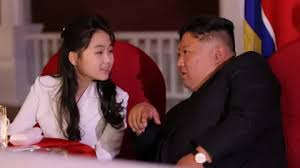
Kim Jong Un Designates Daughter as Heir Amid North Korea's Leadership Transition

Editor 12 Feb, 2026 ... min lectura

South Korea's National Intelligence Service (NIS) has revealed that North Korean leader Kim Jong Un has selected his teenage daughter, Kim Ju Ae, as his successor. This announcement, confirmed by Seoul's intelligence agency to lawmakers on Thursday, marks a significant shift in North Korea's leadership succession dynamics. The decision, based on a range of circumstances including Kim Ju Ae's growing visibility in public events, signals potential changes in the country's political landscape.

The National Intelligence Service (NIS) emphasized that the selection process considered multiple factors, particularly her increasing presence at high-profile international engagements. Recent images show Kim Ju Ae attending key events alongside her father, including a notable trip to Beijing in September—a first known foreign journey for the youth. This visibility, the NIS stated, provides critical insights into her potential readiness for leadership roles within North Korea's complex system.

Kim Ju Ae, described as the only known child of Kim Jong Un, has been gradually emerging from behind the scenes to take part in official functions. Her participation in events such as the National Day parade in 2024 and recent diplomatic meetings has raised questions about her preparedness for the challenges of governing a nation with over 25 million people. The NIS noted that her role in the upcoming North Korean party congress later this month will be closely monitored, as it could determine whether she transitions into a more prominent political role.

Analysts suggest that this move reflects a strategic effort by the regime to ensure continuity while addressing the complexities of a young successor. Kim Ju Ae's age and lack of direct political experience pose challenges, but her familiarity with state protocols and her presence at key events may provide a foundation for future leadership. The decision has sparked discussions about the implications for North Korea's economic stability and international relations, especially given the country's heavy reliance on external aid and trade.

The announcement has drawn comparisons to historical leadership transitions in authoritarian regimes, where succession planning often involves careful evaluation of political capital and loyalty. However, unlike past transitions, this case involves a daughter rather than a close ally or relative, which introduces unique complexities. South Korean officials have not commented on the specifics of the decision, but the NIS's public confirmation suggests a level of confidence in her potential.

Experts caution that North Korea's political structure remains highly opaque, and the actual succession process could involve additional layers of evaluation beyond what has been publicly disclosed. The regime's decision to prioritize a young successor may also be influenced by internal pressures, such as economic challenges and the need for modernization within a system that has struggled with technological advancement and economic stagnation.

While the selection of Kim Ju Ae has been met with mixed reactions globally, it underscores the evolving nature of leadership in authoritarian states. The implications of this decision will likely unfold over the coming months as the daughter's role in the upcoming party congress and subsequent engagements are observed. For now, the NIS's confirmation provides a rare glimpse into North Korea's internal dynamics.