ICE Warehouses: The New Battleground in America's Immigration Crisis

Editor 09 Feb, 2026 ... min lectura

As the U.S. government's focus shifts from traditional immigration enforcement methods to the use of vast, previously unrelated facilities, a growing movement has emerged around the conversion of warehouses into detention centers. This trend, particularly evident in New York and surrounding states, has become a focal point of both policy debates and community resistance. The transformation of industrial spaces into sites for human detention represents a significant shift in how the federal government addresses the complex challenges of immigration control.

The most recent example is the 1.3-million-square-foot former Big Lots warehouse in Tremont, Pennsylvania, which was purchased by U.S. Immigration and Customs Enforcement (ICE) for $119 million. The facility, capable of housing up to 7,500 individuals, has drawn immediate criticism from local residents and advocacy groups. Critics argue that the scale of such operations contradicts the principles of humane treatment and raises profound ethical questions about the government's approach to immigration enforcement.

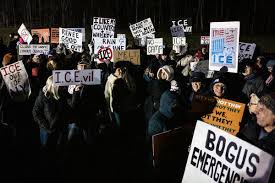
Protests against these conversions have gained momentum across multiple states. In Hudson County, Colorado, a demonstration occurred last month outside a shuttered correctional facility that is reportedly under contract to become an ICE detention center. Local residents, community leaders, and civil rights organizations have organized to oppose the government's plan to transform these spaces into holding facilities. The movement highlights growing distrust in federal authority and a desire for more transparent and community-informed decision-making processes.

Supporters of the federal government's strategy emphasize the need for secure and scalable solutions to manage the influx of migrants. They argue that the current system, which includes traditional detention centers, has been overwhelmed by the volume of individuals seeking asylum or protection. The government's decision to use existing industrial facilities, which are often cheaper and more readily available, is seen as a pragmatic response to the challenges of maintaining a functioning detention system.

Opponents, however, point to the ethical implications of using such large-scale facilities for human detention. The conversion of warehouses into detention centers raises concerns about the dignity and safety of those held within these spaces. Many argue that these facilities, designed for retail and storage, lack the necessary infrastructure for humane treatment, creating a dangerous and often inhumane environment for vulnerable populations.

As the debate intensifies, the role of these warehouses in the broader context of immigration policy is becoming increasingly critical. The government's push to expand its use of these spaces reflects a broader shift in how the federal government addresses the complex and evolving nature of immigration enforcement. This shift has sparked a growing movement of resistance, with communities across the country organizing to challenge the government's use of industrial spaces for human detention.